 3:11
3:11An ethical promise still needs user value
Fairbnb’s publicity did not solve marketplace density and matching problems.
Likely speaker
 SUMMIT & RESEARCH
Free short preview · An ethical promise still needs user value
Session participants: Damiano Avellino. “A good story still needs a useful product.” Autopsy of a Good Idea: Why Platform Coops Didn’t Scale—and What Mutualistic AI Must Do Differently. ECOSYSTEM Summit, Barcelona, 17 September 2026. Session time 0:00–21:35. https://cs-ecosystem.commonshare.workers.dev/talks/autopsy-of-a-good-idea
An interpretation of the recorded conversation.
Damiano Avellino speaks as a Fairbnb co-founder and CEO of Memorize, an AI-adoption business. He explicitly seeks to counter conference enthusiasm with an account of failure. Fairbnb combined a cooperative form, redistribution to local projects and restrictions intended to reduce tourism harms. It attracted extensive publicity and volunteers, but he reports limited host numbers and transactions. Attention and ethical appeal did not establish user value or market liquidity.
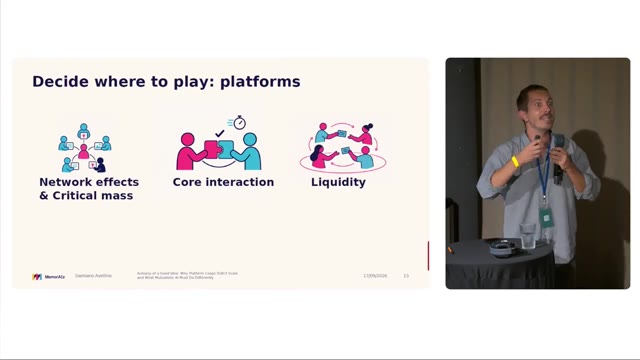
He identifies several distinct constraints: financing incentives, unresolved multi-stakeholder governance, and especially an inadequate customer proposition. Network geography, synchrony of transactions and critical mass shape the difficulty of launching a platform. His comparison with ride-hailing offers one perspective; the Drivers Cooperative session provides a separate account. The alternative organisation was not necessarily a better platform. A tool providing value to its first user can be a different entry route from a marketplace requiring many participants.
His current strategic proposal places effort in AI adoption, context, interfaces and organisational workflows, rather than competing at the frontier-model or chip layer. Some elements are practitioner observations; hardware capabilities, an impending bubble and a three-to-five-year window are predictions, not established facts. Control is selective: shared context infrastructure and agent capabilities should avoid lock-in, while interchangeable models may remain externally supplied. This use of control is architectural portability, not demonstrated legal ownership or democratic accountability.
The Q&A makes the stack more concrete: context and knowledge base, branded assistants, and agentic capabilities. An open-source orchestration framework is named, but no live performance or comparative evaluation is shown. The speaker has a commercial interest in this adoption layer. The failure analysis connects network structure with value for users. A cross-session tension concerns where alternative R&D should focus: on new models or on other parts of the technology stack.
3:11Fairbnb’s publicity did not solve marketplace density and matching problems.