 2:19
2:19Whose readiness are we measuring?
The final exchange brings data feminism, intersectionality and an Afrofeminist lens into the readiness discussion.
Likely speaker
Unidentified audience participant
 SUMMIT & RESEARCH
Free short preview · Whose readiness are we measuring?
Session participants: Caryl Feldacker; Linda Raftree; Varaidzo Matimba; Christina Filipovic; Bhaskar Chakravorti. “Connected does not mean ready.” Connected ≠ Ready: Getting to a Ground-Level View of AI Readiness for Women and Vulnerable Populations. ECOSYSTEM Summit, Barcelona, 16 September 2026. Session time 0:00–1:28:20. https://cs-ecosystem.commonshare.workers.dev/talks/connected-is-not-ready
An interpretation of the recorded conversation.
This extended session combines introductory presentations, a recorded in-room workshop led by Caryl Feldacker, and plenary feedback from parallel groups. Varaidzo Matimba moderates; Linda Raftree and Bhaskar Chakravorti present; Christina Filipovic and a participant introduced as Kim contribute to group facilitation or feedback. Caryl explicitly speaks in a personal capacity, not for the Gates Foundation. Other breakout rooms are not directly captured; only their reported takeaways enter this recording.
The session's central distinction is between nominal connectivity and effective, changing capacity to use digital services. Device ownership, affordability, charging, functionality, literacy, skills, social norms and agency all matter. National averages can obscure subnational and gendered differences. Reported surveys in Benin and Bangladesh and rapid mixed-method work in northern Nigeria suggest that breaks in access are common and multidimensional. These figures use different denominators and time windows, limiting direct comparison.
Digital personas reconstruct women's trajectories from deep qualitative interviews linked to vulnerability segments. Caryl repeatedly warns that the categories and population approximations are imperfect and that the small qualitative sample is not representative. The tools orient questions rather than establish exact prevalence. Connectivity can regress or fluctuate because of job loss, device damage, sharing, coercion or household demands; a unidirectional ladder is an approximation. A statement that a participant reports no phone-safety concern is not evidence of absence of harm, particularly where she has no independent access.
Bhaskar describes an in-progress 27-country model, with subnational work in roughly half, using four readiness stages and simulated interventions. The goal is development outcomes, not AI use for its own sake. Modelled drivers and simulated shifts are not demonstrated causal policy effects. Linda argues that recent local events and social relations may make aggregate data obsolete. Her example of women avoiding phones because of harassment illustrates a mechanism invisible to conventional access metrics. Formative research, local partners and co-design therefore complement the dashboards.
Toolkit fatigue and unrealistic gold standards are practical constraints: small organisations may lack funds and feel blamed for not meeting extensive guidance. The proposed guidance adapts existing knowledge into feasible research plans. The workshop asks whether to fund a hypothetical advisory intervention, using different tools to reveal what remains unknown. This is an exercise, not an actual funded programme or impact result.
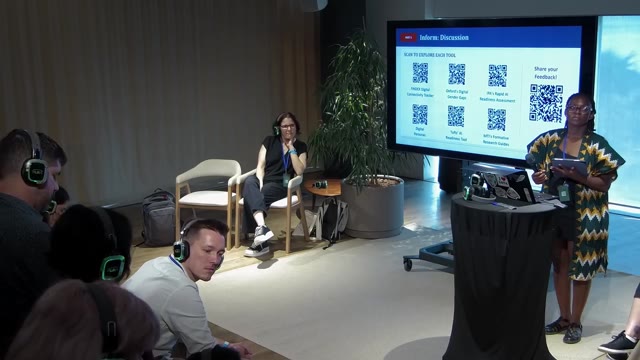
In the recorded in-room workshop, digital-gender-gap estimates use platform advertising data and disclose limitations; the speaker does not claim to know every method. Personas are used to consider literacy, intermediaries, norms and the appropriateness of channels. Mediated access is offered as one option, not proof that proxy provision is safe or preferred. An audience question presses for identifying who mediates access, including male gatekeepers versus other women. Another asks how the data stays current; the answer explicitly rejects perpetual funding and asks users to repeat or adapt local research.
The plenary widens the unit of analysis. Participants ask about linking formative work to routine monitoring, distinguishing coverage from actual effectiveness, including households and community services, and considering AI creation as well as consumption. Responses propose consented reuse and common questions, limited studies where resources are scarce, and broader systems research. Starting only with smartphone owners may exclude the intended population before an intervention begins. The final GIZ intervention calls for data feminism, intersectionality, consent and scrutiny of power in models, rather than only readiness of recipients. Varaidzo agrees and explicitly invokes an Afrofeminist lens.
Evidence types include reported studies, methods explanations, demonstrations, illustrative scenarios and audience challenges. Underlying datasets, model validation and full interview records are not independently reviewed. Geographic and numerical claims remain attributed. Important unanswered questions concern causal validation of readiness modelling, sustainable updating, effective agency in mediated access and whether proposed services solve locally chosen problems.
2:19The final exchange brings data feminism, intersectionality and an Afrofeminist lens into the readiness discussion.