 1:02
1:02Owning shares does not settle market power
A share of profits and influence over dominant firms are separate questions.
Likely speaker
 SUMMIT & RESEARCH
Free short preview · Possible alternatives, unequal ability to build them
Session participants: Bhaskar Chakravorti; Jan Eeckhout; Nuria Oliver; Hamid Rashid. “Who controls the gains from AI?.” Market Power, AI, Development and Freedom – Paths Forward. ECOSYSTEM Summit, Barcelona, 17 September 2026. Session time 0:00–55:11. https://cs-ecosystem.commonshare.workers.dev/talks/market-power-ai-freedom
An interpretation of the recorded conversation.
The panel offers three approaches to concentrated AI power: Jan Eeckhout emphasises competition and regulated access; Nuria Oliver emphasises trustworthy systems, independent research, talent and alternatives; Hamid Rashid emphasises distribution, developing-country bargaining constraints and taxation. Bhaskar Chakravorti frames a race in which unilateral restraint is unstable without binding coordination. There is no audience Q&A; the close explicitly says there is no time.
Eeckhout distinguishes owning shares in dominant firms from changing their market conduct. Scale can create real efficiencies while concentrated control retains gains and constrains rivals. Cross-holdings are presented as a mechanism of concentration, but the strong claim that several firms act as a single monopoly is an argument, not an adjudicated market finding. His innovation comparisons and historical wage statistics require their original studies for independent assessment. He explicitly says current aggregate AI effects are not yet visible in the macro data, qualifying forecasts presented elsewhere in the same panel.
Oliver rejects equating all innovation with progress and sees reliable, contestable, privacy-respecting AI as a possible competitive advantage. She distinguishes European scaling barriers from regulation and argues for smaller, locally appropriate models. Rashid challenges the comparability of international trust percentages and warns that cheaper labour and export-led catch-up could be undermined by automation. His strong predictions of inequality and conflict are scenarios rather than established outcomes. His portrayal of national data regimes and example of telecom rebates are simplified and unverified.
The most useful disagreement concerns feasible alternatives. Oliver cites Canadian initiatives and small-model possibilities; Rashid replies that Canada has resources and weaker states face external political pressure, little capital and limited bargaining power. They agree on desirability but differ on transferability and constraints. The exchange supports separating technical feasibility from effective institutional agency. Neither account establishes what every lower-income country can do.
Policy proposals also remain contested: regulated interoperability and information quality, civil-society and research capacity, and taxes on model size or token flows. Oliver's final reply that local inference need not use cloud flows qualifies the proposed tax base. Global coordination, jurisdictional avoidance and public consent are unresolved implementation conditions. The transcript's legal allegations, technology specifications and global-tax descriptions are not independently verified.
1:02A share of profits and influence over dominant firms are separate questions.
 3:33
3:33Local-model optimism meets a challenge about resources and bargaining power.
 1:11
1:11Nuria Oliver explains why AI infrastructure depends on talent, opportunity and support for people whose work is changing.
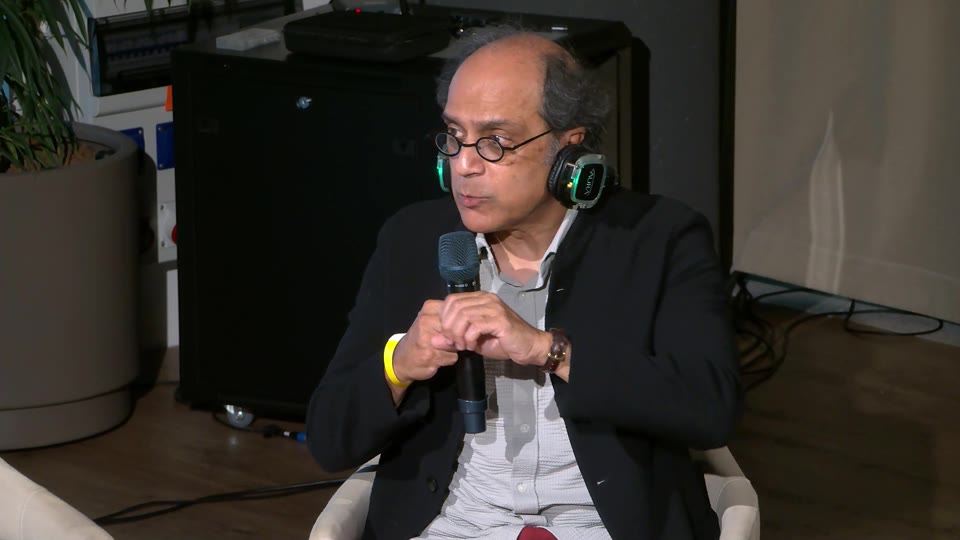 1:24
1:24Bhaskar Chakravorti connects competition, institutions and public agency as starting points for changing who benefits from AI.