 0:51
0:51Ownership beyond existing savings
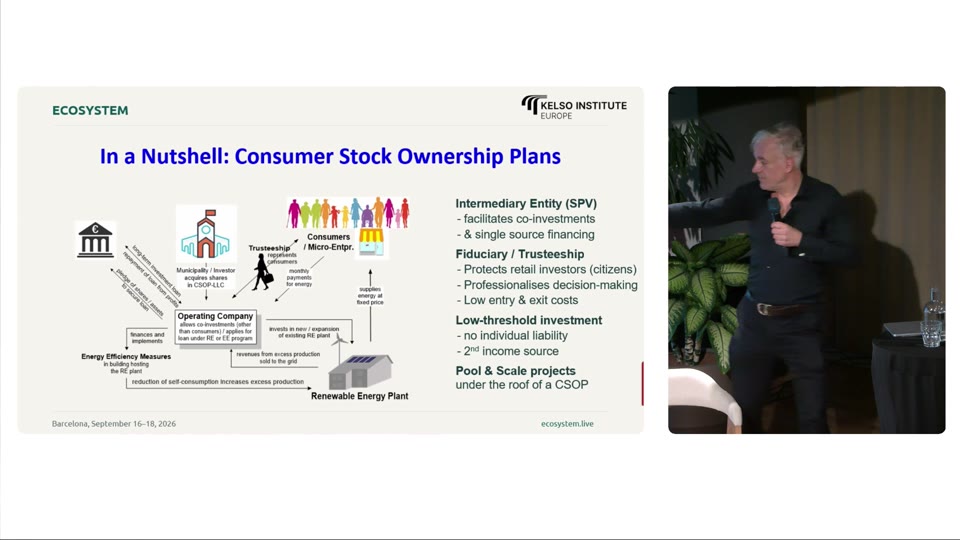
Jens Lowitzsch explains how a renewable-energy ownership model uses trusteeship and future returns to include people without existing savings.
Likely speaker
 SUMMIT & RESEARCH
Free short preview · Ownership beyond existing savings
Session participants: Jens Lowitzsch. “How can more people own productive assets?.” Kelso’s Vision: Ownership at the Center of Inclusive Economies. ECOSYSTEM Summit, Barcelona, 17 September 2026. Session time 0:00–21:56. https://cs-ecosystem.commonshare.workers.dev/talks/ownership-inclusive-economies
An interpretation of the recorded conversation.
Jens Lowitzsch presents the Kelso vision from his roles in comparative law and the Kelso Institute Europe. The intervention is advocacy and institutional design informed by a particular economic theory, not a neutral consensus account of economics. He frames automation as a distributive problem: who owns productive assets when labour's relative contribution or income share falls? Aristotle is quoted as a historical analogy.
The two-factor account treats labour and capital as distinct sources of productive contribution and argues for wider access to capital income. The speaker reports historical wage-share trends and invention/implementation histories, which are not independently assessed here. Alternative explanations of labour shares and contested theory are not developed in the talk. The practical focus is leveraged ownership acquisition repaid from future enterprise returns rather than workers' or consumers' existing savings.
A distinction between employee, consumer and wider citizen constituencies addresses exclusion: an employee-only plan cannot directly include everyone without employment. The reported fertilizer-plant example is used to show how consumer ownership could challenge supplier market power, while employee succession solves a problem for an exiting owner. The theory is that different incumbent incentives help explain different replication trajectories. This is an attributed historical interpretation, not a demonstrated comparison.
For renewable energy, the consumer plan combines an operating company, a fiduciary representative for individual consumers, other investors, and one loan secured at company level. Future energy payments service investment while the trustee is intended to professionalise collective decision-making. Lower entry barriers and no individual liability are described properties of this design, not a legal assurance for any actual project. The fiduciary relationship may itself raise accountability questions that are not examined in the talk.
The heterogeneity challenge connects municipalities, enterprises and households with different interests and energy-use profiles. The proposed vehicle seeks to combine inclusive participation, financing efficiency, professional management and local acceptance. No completed case evaluation of this contemporary model is presented. The financial mechanism raises questions about risk, trustee accountability and assumed future cash flows.
0:51Jens Lowitzsch explains how a renewable-energy ownership model uses trusteeship and future returns to include people without existing savings.