 1:14
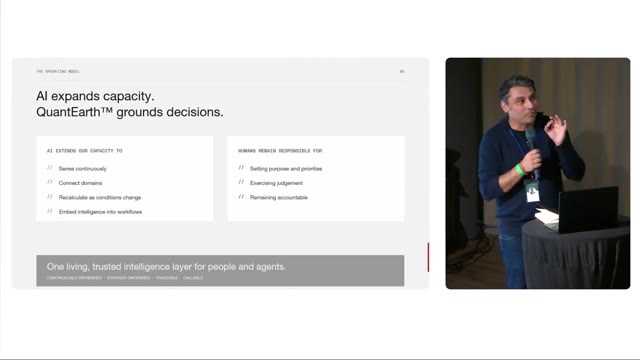
1:14A risk model still needs human judgement
Methods, assumptions, purpose and escalation remain decisions people must own.
Likely speaker
 SUMMIT & RESEARCH
Free short preview · Forty shots on goal
Session participants: Martin Smith; Iggy Bassi; Karan Chopra. “From scattered risk signals to decisions.” Resilience and Intelligence: Building a Decision Intelligence Layer for Trade. ECOSYSTEM Summit, Barcelona, 18 September 2026. Session time 0:00–32:29. https://cs-ecosystem.commonshare.workers.dev/talks/risk-signals-to-decisions
An interpretation of the recorded conversation.
Martin Smith presents a joint product with Iggy Bassi and Karan Chopra of Earthena. The session combines practitioner origin stories, an explanation of multi-domain risk modelling and a first-version interface demonstration. It is a commercial collaboration. The speakers' past farming and climate-model work informs their motivation, but does not independently validate the current product.
The central problem is how to turn abundant data into decisions about scarce inspection, sourcing and operational resources. Risks can compound across climate, energy, water, geopolitics and social conditions, and cascade through connected facilities. A Ghana processing-plant storm loss illustrates why earlier risk information might matter; the smallholder discussion highlights unequal ability to absorb shocks. These are reported experience and counterfactual reasoning, not proof that the new system would have prevented those losses.
The proposed translation layer combines external hazard models with internal spend, sourcing concentration and transaction context. Metrics such as disruption days or heat-related work constraints are intended to make signals relevant to a decision. The speakers say methods, sources and assumptions travel with the product so users can defend their choices. Calibration, ground validation, uncertainty propagation, false positives and comparative decision performance are not shown. A modelled regional risk at a facility is not evidence that the facility committed a violation.
Human roles are stated as setting purpose, priorities and escalation thresholds. The subsequent interface presents suggested actions, creating a useful design question: how do users retain judgement when a system supplies a daily task list? No audience question probes that tension and no usability study is presented. The demonstration shows external risk layered on a permissions graph, requests for structured evidence and verification, plus monitoring and action-oriented views. Product and transaction risk are described as planned functions for a later rollout.
The speakers recognise the risk of CommonShare becoming a single point of failure and connect later sessions to interoperating with competing platforms. Custom weights and additional local data are proposed, but customisation is not automatically better calibrated or more legitimate. End-to-end federation and resulting social or financial benefits are not established.
1:14Methods, assumptions, purpose and escalation remain decisions people must own.