 2:23
2:23Interest is not the same as access
The adoption gap starts before installation: devices, data cost and household control.
Likely speaker
 SUMMIT & RESEARCH
Free short preview · Interest is not the same as access
Session participants: Alexandre Cheval; Tsito Raharison; Erik van Ingen; Tetyana Zelenska. “Who pays for AI that works for farmers?.” Capital for AI for Agriculture. ECOSYSTEM Summit, Barcelona, 16 September 2026. Session time 0:00–39:45. https://cs-ecosystem.commonshare.workers.dev/talks/capital-ai-agriculture
An interpretation of the recorded conversation.
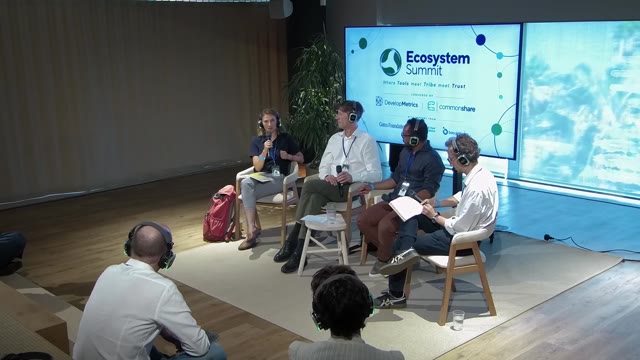
This panel compares an agricultural asset investor, FAO and Digital Green. The moderator explicitly acknowledges that no farmer is on the panel; speakers' contact with farmers does not substitute for farmer participation. Signature reports faster desk due diligence followed by field agronomy, not replacement of fieldwork. Its commercial-farm-as-knowledge-hub proposal may lower infrastructure and learning costs, but the moderator asks for evidence and FAO says it is a new idea to take forward. No demonstrated spillover effect or governance arrangement is established.
FarmerChat examples concern timely fertiliser advice, a farmer's improved negotiating position at an input shop, and adapting advice to resources already on a farm. These are reported anecdotes. The stronger cross-case mechanism is hyperlocal relevance: soil, weather, language and domain-specific transcription errors can change the meaning of advice. Existing general language support is insufficient evidence of agricultural reliability. Digital Green describes benchmarking work and FAO a possible shared validation foundation, without a mature cross-sector funding settlement.
Trust remains an open research question. Digital Green describes moving beyond digital-only advertising to extension agents, self-help groups and blended peer discussion. Its reported approximately 35% female active-user share cannot be interpreted as women being less interested: women who use the tool are described as at least as active, while shared devices, installation data costs, confidence and household gatekeeping affect entry. Zero-rated use does not remove the cost of installation. Existing Ethiopian extension networks can mediate indirect use by people without smartphones; this is more expensive than digital-only acquisition.
FAO's pre-competitive space aims to support common foundations and room for lower-income-country agripreneurs, while recognising the event's affluent-country and predominantly white participation. The Q&A challenges winner-picking philanthropy that rewards organisational silos. Blended finance and joint use-case mandates are offered as possible responses, with unresolved alignment costs. A final question asks for a durable infrastructure funding model beyond an enthusiastic funder. The brief response names validation work but does not establish such a model.
2:23The adoption gap starts before installation: devices, data cost and household control.