 1:18
1:18Who funds safety after the pilot?
A practitioner challenges short grants that leave nobody to monitor deployed systems.
Likely speaker
Unidentified audience participant
 SUMMIT & RESEARCH
Free short preview · Research has to happen during deployment
Session participants: Grace Lyn Higdon; Becky Faith; Rachel Coldicutt. “Responsible AI needs continuing attention.” Responsible AI: Ethics, Governance and Practice. ECOSYSTEM Summit, Barcelona, 16 September 2026. Session time 0:00–49:09. https://cs-ecosystem.commonshare.workers.dev/talks/responsible-ai-in-practice
An interpretation of the recorded conversation.
Grace Lyn Higdon moderates Becky Faith (explicitly in a personal capacity, with IDS/FCDO experience) and Rachel Coldicutt (Careful Industries, discussing research for Lloyd's Register Foundation). Melissa Omino is introduced as a hoped-for remote participant; the recording does not establish that she joined. Her work on a Kenyan language dataset and community-defined benefit-sharing licence is described by the moderator and must remain attributed as a second-hand account.
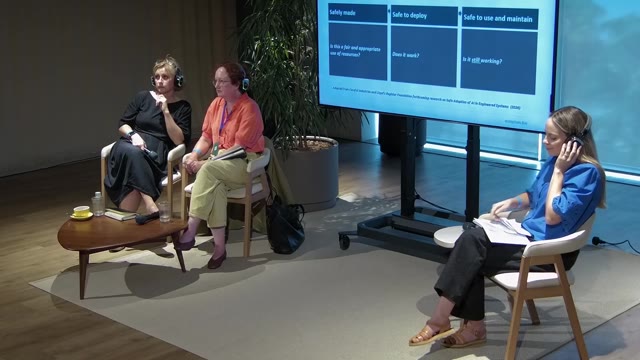
The session distinguishes safely made, safe to deploy, and safe to use and maintain. Faith argues for contextual evidence, equitable partnerships, coordination among funders and locally led capacity. Coldicutt distinguishes narrow purpose-built models from general models whose language and cultural assumptions require substantial adaptation. She recognises a real opportunity cost of waiting for alternatives, while insisting that adaptation requires ongoing scrutiny. Distributed harm can remain invisible where marginalised users cannot credibly report it.
The most concrete implementation challenge comes from an audience practitioner: a short consultant contract can fund initial assessment but leaves no capacity to monitor changing upstream models. Coldicutt proposes coalitions of maintenance and a culture of safety. Faith mildly disagrees over whether safety should be incorporated into the evaluation playbook: an incremental minimum viable evaluation can still help. This is a difference in implementation emphasis, not a binary opposition between evidence and values.
The politics of alternatives is explicit: investing only in adapting dominant providers' products may reinforce their power and displace alternative R&D. Practitioner examples of co-designed social-work tools and small contextual enterprises are suggestive reported cases, not independently measured outcomes here. An audience objection warns that technically safe AI can still accelerate inequitable institutional processes. That question remains only partly answered; optimism about collaboration coexists with pessimism about an abundance of mediocre tools.
Evidence includes descriptions of evaluation programmes, research fieldwork, practitioner constraints, normative criticism, examples and questions. The underlying studies and product outcomes are not independently assessed here.
1:18A practitioner challenges short grants that leave nobody to monitor deployed systems.