problem definition
How a need, task or desired outcome is framed before choosing an intervention.
Where the boundary lies
A technology capability without an articulated need is not problem definition.
See an example → SUMMIT & RESEARCH
How do tools fit the workflow, context and continuing capacity of real organisations?
How a need, task or desired outcome is framed before choosing an intervention.
A technology capability without an articulated need is not problem definition.
See an example →Embedding tools, evidence and actions in an operational sequence.
Standalone model capability does not establish usable organisational integration.
See an example →Staff time, skills, organisational resources or complementary capability required to act.
A rule assigning responsibility does not establish capacity to fulfil it.
See an example →Resources and practices needed to keep a system useful and safe after launch.
A rapid first build or one-off pilot is not maintained service.
See an example →Modification or limits required by local language, setting, sector or task.
Repetition of the same product across sites is not evidence of adaptation.
See an example →Actual uptake, sustained use or the gap between attention and useful use.
Publicity and volunteer enthusiasm are not equivalent to customer transactions.
See an example →Whether systems function consistently under intended conditions.
Technical functioning alone does not establish fair institutional purpose.
See an example →Concrete routes or open operational questions about moving from proposal to practice.
An aspiration without a practical route remains normative framing.
See an example →Replacement or augmentation of tasks through robots or AI and the organisational response.
The event repeatedly names a missing step between producing an answer and changing a decision. Evidence may reveal conflicting priorities without resolving them.
Follow the evidence →Charging, installation costs, household relations, usable language and trusted intermediaries determine whether a service reaches people. Starting with current users can hide exclusion.
Follow the evidence →Permanent monitoring, operational expertise, context and a stable funding horizon must accompany technical capability. Early attention or fundraising is not an impact result.
Follow the evidence → 1:01
1:01Start with the workflow, human decisions and intended benefit.
 1:18
1:18A practitioner challenges short grants that leave nobody to monitor deployed systems.
 1:47
1:47Why trials, qualitative knowledge and institutional analysis answer different questions.
 2:23
2:23The adoption gap starts before installation: devices, data cost and household control.
 3:11
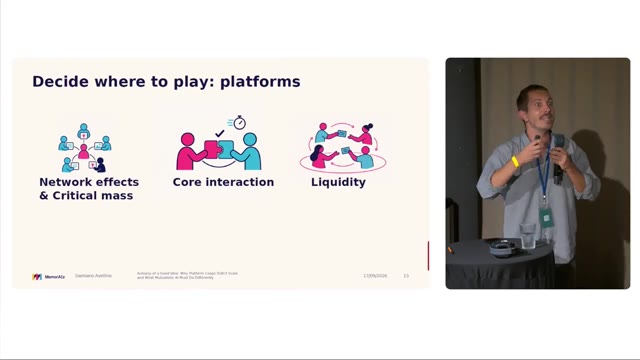
3:11Fairbnb’s publicity did not solve marketplace density and matching problems.
 2:57
2:57Overseas subsidiaries expose the limits and conditions of a shared-ownership model.
Themes can overlap. Counts describe this collection; they do not measure importance, agreement or prevalence outside the event.