evaluation
How performance or effects are assessed, including research evidence and criteria of credibility.
Where the boundary lies
A persuasive anecdote without assessment is not an evaluation method.
See an example → SUMMIT & RESEARCH
What does a record establish, how was it assessed, and what remains uncertain?
How performance or effects are assessed, including research evidence and criteria of credibility.
A persuasive anecdote without assessment is not an evaluation method.
See an example →Continuing assurance, monitoring, feedback and improvement over a system's life.
A one-time origin record does not establish ongoing assurance.
See an example →Investigating and addressing impacts or claims with substantive verification beyond formal compliance.
Knowing where a material came from is not sufficient due diligence.
See an example →Origin, chain of custody and correspondence between records and their source.
Origin alone does not prove responsible production or beneficial outcomes.
See an example →Shared definitions, normative requirements or certification schemes and their scope.
A common technical field is not automatically a sustainability requirement.
See an example →Separation of evidence, expertise or organisational information that impedes use or learning.
Different valid proof requirements need not be an organisational silo.
See an example →Explicit learning from failure, disappointing results or ineffective practice.
A hypothetical risk alone is not a reported failure experience.
See an example →The event repeatedly names a missing step between producing an answer and changing a decision. Evidence may reveal conflicting priorities without resolving them.
Follow the evidence →Origin, chain of custody, valid proof, due diligence and social outcomes are different claims. Reuse can reduce work only while preserving the relevant verification conditions.
Follow the evidence →More complete checking can expose failings while making a verifier commercially less attractive. Human judgement, consequences and shared expectations are necessary complements to automation.
Follow the evidence →The corpus contains studies, practitioner accounts, demonstrations, proposals and questions. These establish different things. Local knowledge and negative cases can reveal what a generic measure misses.
Follow the evidence → 1:01
1:01Start with the workflow, human decisions and intended benefit.
 1:47
1:47Why trials, qualitative knowledge and institutional analysis answer different questions.
 2:23
2:23The adoption gap starts before installation: devices, data cost and household control.
 3:11
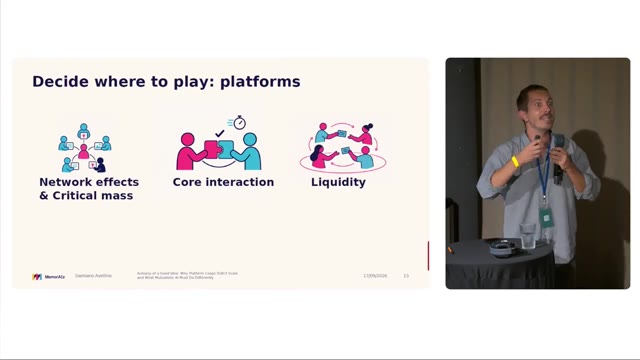
3:11Fairbnb’s publicity did not solve marketplace density and matching problems.
 1:43
1:43Sharetribe’s founders retained voting control before a later democratic transition.
 2:52
2:52A study distinguishes representation, votes and the power to stop a decision.
Themes can overlap. Counts describe this collection; they do not measure importance, agreement or prevalence outside the event.