shared infrastructure
Reusable common foundations serving multiple organisations or applications.
Where the boundary lies
A proprietary product used by many clients is not thereby a governed commons.
See an example → SUMMIT & RESEARCH
What can be shared, on whose terms, and who maintains it?
Reusable common foundations serving multiple organisations or applications.
A proprietary product used by many clients is not thereby a governed commons.
See an example →Ability of systems to exchange meaningfully compatible data or functions.
Interchange alone does not establish permissions, ownership or enforceable rights.
See an example →Entitlements and conditions governing access, use, control or benefits from data.
A technically possible transfer does not establish lawful or fair rights.
See an example →Ability to leave an institution or switch provider, including technical portability and its conditions.
Reusing data or assurance across requests instead of repeated collection or verification.
Reliance on providers or components outside the deployer's control.
Use of an external interchangeable component need not establish lock-in.
See an example →Safeguards and concerns about unauthorised access, disclosure or leakage of data.
Data ownership, consent, price and other entitlements require data_rights; secure storage alone does not establish them.
See an example →Interoperable records do not establish a commons. Maintenance, disclosure rules, liability and credible commitments determine whether sharing survives.
Follow the evidence →Origin, chain of custody, valid proof, due diligence and social outcomes are different claims. Reuse can reduce work only while preserving the relevant verification conditions.
Follow the evidence →A live farmer-payment challenge exposes the gap between a rights-bearing architecture and a funded exchange. Bargaining, buyer demand and redistribution of savings remain proposed mechanisms.
Follow the evidence → 1:18
1:18A practitioner challenges short grants that leave nobody to monitor deployed systems.
 2:09
2:09An API change exposed the recurring costs and legal responsibilities of shared data.
 2:36
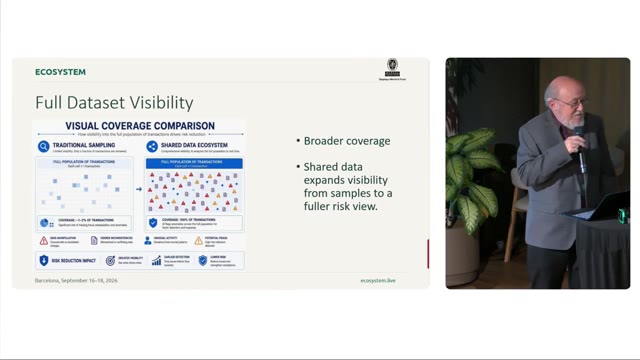
2:36More complete checks can reveal problems while creating a commercial penalty for the verifier.
 3:23
3:23An objection is followed by proposals on bargaining power and audit savings—not evidence of payment.
 3:33
3:33Local-model optimism meets a challenge about resources and bargaining power.
 2:19
2:19The final exchange brings data feminism, intersectionality and an Afrofeminist lens into the readiness discussion.
Themes can overlap. Counts describe this collection; they do not measure importance, agreement or prevalence outside the event.